
Operating a commercial rig across demanding routes requires a fine balance between sheer force and dependable efficiency. While adding horsepower may sound like an easy fix for sluggish response, unlocking reliable and usable engine performance requires precise heavy truck ECM tuning.
The Engine Control Module (ECM) serves as the digital brain of your powertrain, governing fuel injection timing, boost pressures, and sensor feedback to optimize power delivery while preserving total engine longevity.
Understanding the Core Difference: Horsepower vs. Torque
To make informed decisions regarding heavy truck ECM tuning, fleet owners and owner-operators must distinguish between torque and horsepower. Torque measures rotational force generated at the engine’s crankshaft—the immediate pulling strength needed to launch an 80,000-pound combination load from a complete stop or haul up an 8% grade.
Horsepower, by contrast, is a calculation of work completed over time (Torque × RPM / 5252). In simple terms, torque moves the load, while horsepower dictates how fast you can sustain momentum at highway cruising speed. During custom heavy-truck ECM tuning, experts recalibrate the torque curve to deliver low-end grunt without overstressing internal engine components.
When modifying ECM software to excessively increase low-RPM torque without evaluating the rest of the powertrain, it puts massive mechanical strain on the clutch, transmission input shaft, driveshafts, and rear differentials. Conversely, throwing extra fuel into the cylinders to boost high-RPM horsepower without adequate turbocharger airflow dramatically raises exhaust gas temperatures (EGTs). This leads to heat distortion, piston damage, and wasted fuel. Balanced tuning expands the usable RPM powerband safely within mechanical design thresholds.
Key Factors in Determining Safe Power Targets
Every commercial vehicle operates under distinct conditions. Generic off-the-shelf tunes often fail because they ignore the physical realities of individual trucks. Safe, effective performance enhancement requires evaluating several variables:
- Engine Health & History: Overall mileage, maintenance record, injector wear, and baseline compression dictate how aggressively parameters can be safely adjusted.
- Drivetrain Limitations: Transmission torque ratings, clutch holding capacity, axle ratios, and intercooler efficiency must align with new power levels.
- Operating Duty Cycle: A heavy-haul rig tackling mountain passes daily requires a completely different calibration strategy than a long-haul highway transport or regional day-cab outfit.
- Environmental Compliance & Airflow: Calibrations must comply with applicable emissions regulations and match fuel delivery to actual boost pressure to maintain clean, complete combustion.
The MHPD Dyno Calibration Strategy
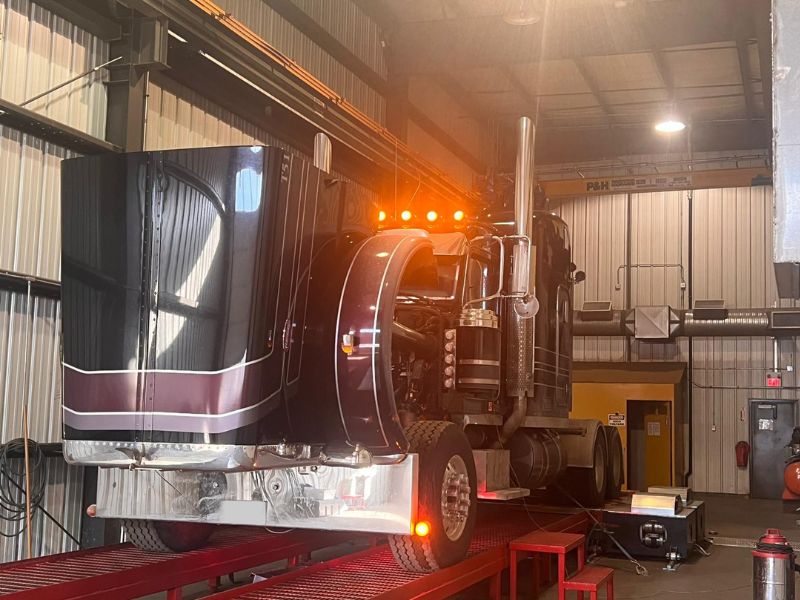
At MHPD, we bypass canned tuning files in favour of tailored solutions designed to meet the real-world demands of heavy-truck ECM tuning. Our process begins with thorough diagnostic sweeps, fault code evaluations, and mechanical checks to assess the engine’s baseline health. We then run full diagnostic baselines on our in-house tri-drive dyno.
By capturing real-time load data, our technicians refine fuel maps, turbo boost curves, and injection timing to deliver reliable semi truck tuning. After re-flashing the ECM, we perform rigorous follow-up dyno runs under full simulated loads to confirm torque gains, check operating temperatures, and verify long-term engine protection.
Maximize Your Engine’s Potential Safely with MHPD
Unlocking horsepower and torque shouldn’t come at the cost of premature component failure or excessive fuel burn. Professional heavy-truck ECM tuning provides the precise power curves needed to tackle steep grades effortlessly, improve driving comfort, and reduce strain on your drivetrain. Contact MHPD today to schedule your customized dyno-proven calibration session and start exploring strategies to improve your fleet’s efficiency and performance!